Copper Mesh for Slugs Reviewed: The Big Comparison. Which One Works Best?
If you’ve landed on this page, you’re probably this close to giving up. Your lettuces are riddled with holes, your dahlias mowed to the ground, and you’re after a genuine review of copper mesh for slugs before you throw in the towel completely.
But you’re hesitating. And rightly so.
On the forums, copper is a divisive subject: for some it’s miraculous, for others it’s an outright con. So who do you believe?
The honest truth, with full transparency: before we go any further, I owe you complete openness. I’m the creator of the Springday mesh featured in this comparison. You might be thinking to yourself: “He’s both judge and jury here, this article is biased.”
Let me explain why the opposite is actually true. I didn’t create my mesh for the fun of selling metal. I created it because, like you, I was a frustrated gardener. I tried the old wives’ remedies, the cheap 2 cm netting: failure. I tried the standard round mesh: hit-and-miss results.
It was precisely because I couldn’t find anything reliable on the market that I spent months analysing and testing slug-repelling methods (and sharing my research and findings with you: more than 100 articles on the subject of slug repellence on this blog, and around fifteen video tests of slug barriers on my YouTube channel) in order to design a solution that genuinely works.
This comparison isn’t here to tell you “buy mine”. It’s here to explain to you mechanically why some types of netting fail and why others succeed, based on three scientific criteria:
1. Physics: The contact surface (the secret behind electrical intensity).
2. Chemistry: The purity of the copper (for oxidation).
3. Practicality: The tension of the mesh (often overlooked).
Here is my technical analysis – expert to gardener (I think I can now consider myself an expert on the subject of slugs) – so that you stop throwing your money out of the window.
I. The test criteria: How do you judge a good slug netting?
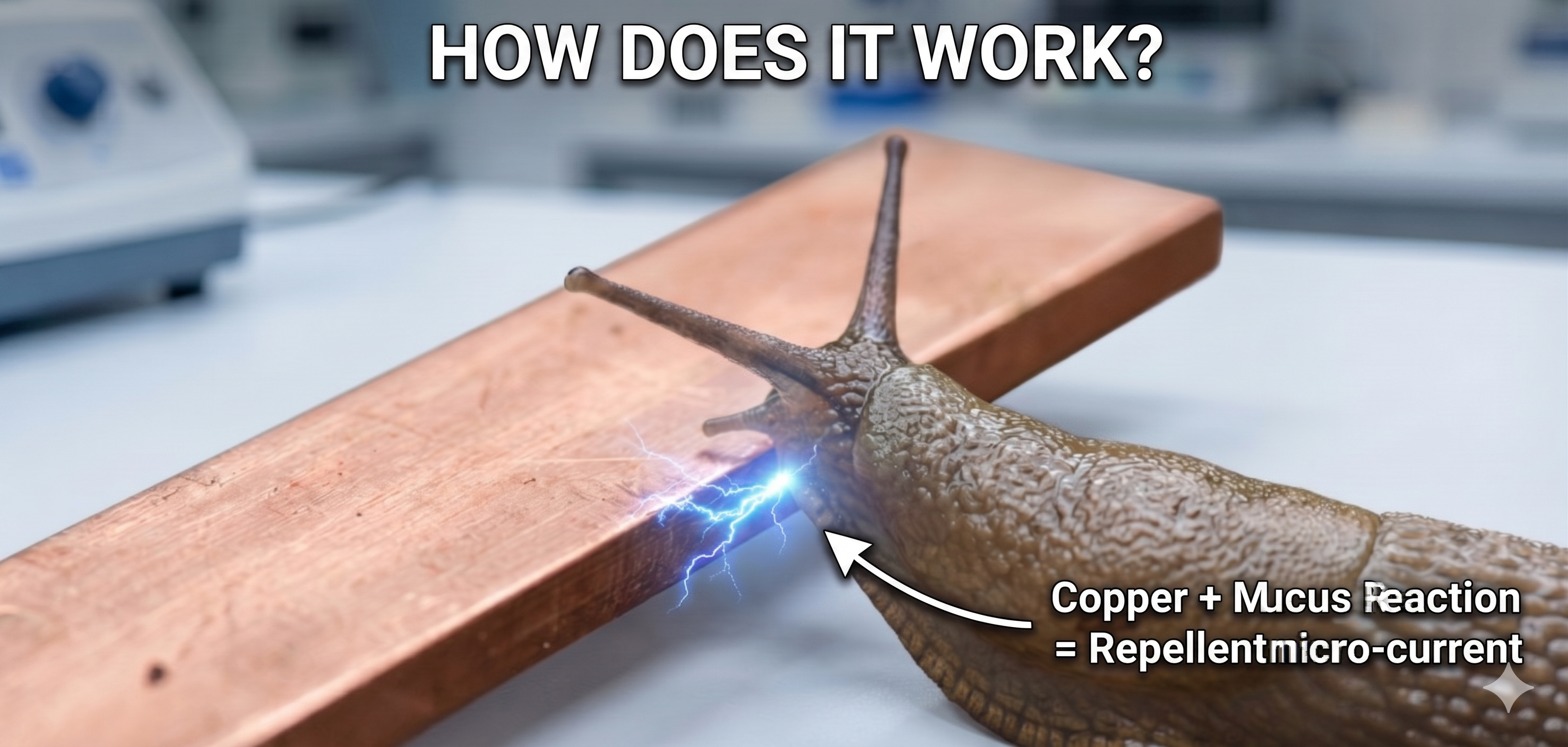
Before I give you my verdict on the various models, it’s essential to understand the mechanics behind it all. Why does copper repel slugs? It isn’t magic, it’s electrochemistry.
When a slug’s mucus (acidic and salty) touches the copper, an oxidation reaction takes place, generating a micro electrical current (a galvanic reaction). For the slug, it’s an unpleasant sensation, comparable to a small static shock, that forces it to turn back.
But for this reaction to be strong enough to stop a determined gastropod, three technical criteria have to come together.
1. The effectiveness of the contact (The Mesh)
This is the most frequently ignored point, and yet it’s pure physics: the intensity of the shock felt is proportional to the area of skin in contact with the metal.
This is where the shape of the wire that makes up the mesh changes everything:
-
Round-wire mesh (cable type): Picture a ball resting on a garden hose. The contact is said to be “tangential”, meaning it only happens at a tiny point. The exchange surface is small, so the electrical reaction is too.
-
Flat-wire mesh (ribbon type): Now picture that same ball resting on a plank. The contact happens across an entire flat face. The exchange surface is multiplied, which maximises the intensity of the repellent reaction.
2. The purity of the material (The Chemistry)
Beware of appearances. In a photo, every type of netting has that lovely characteristic reddish colour. In reality, though, many “cheap” products are alloys (brass, coloured zinc, or a nylon/copper blend).
Why is this a problem? Because the repellence is a chemical reaction. To achieve optimal conductivity and trigger that famous micro-current on contact with the mucus, you need Pure Copper (>99%). Alloys or mixed netting (plastic/metal) conduct electricity far less well and often oxidise in an ineffective way, rapidly losing their repellent power.
3. The installation experience (The Tension)
Finally, a good mesh is one that stays standing. This may seem obvious, but it’s the number-one cause of the failures I’ve been able to observe.
A slug is opportunistic: if your mesh is slack, if it sags between two stakes or gapes at ground level, it will go over the top (or underneath) without even touching enough copper to be bothered. So when you buy, you need to look at what’s included: are you receiving a “bare roll” (in which case it’ll be up to you to rig up your own stakes and fixings, with the risk of imperfect tension) or a complete kit with the right tensioning hardware? The difference in results often comes down to exactly that.
II. Detailed reviews of the 3 types of copper mesh for slugs on the market
1. Review of the “Budget” netting (2-3 cm strip)
You’ve almost certainly come across it online or in discount shops under various “own-brand” labels. It’s a thin braided strip, often mixing copper and nylon strands, with a derisory height of 2 to 3 cm.
✅ What’s appealing (the strong points):
- The attractive price: On paper, the price tag is very tempting. It’s often the cheapest on the shelf.
⚠️ What to watch out for (the critical weaknesses):
-
The geometry problem: This is the major flaw. An adult grey field slug (Deroceras reticulatum) has a remarkable ability to stretch. Faced with a 2 cm obstacle, it doesn’t perceive it as a barrier but as a simple step on a staircase. It clears it in a single stretch.
-
Insufficient contact time: By stepping over it quickly, the slug limits its contact with the copper to a fraction of a second, which isn’t enough to trigger the electrical repellence.
-
The “headache” installation: The netting is so short that it’s impossible to bury it partially to secure the base, or to weigh it down properly with stones without crushing it completely.
-
The ground seal: Unless you have ground as flat as a billiard table (which doesn’t exist in a vegetable patch), the slugs will get underneath through the slightest gap left by the clods of earth.
My verdict: If you’re growing in pots on a balcony on the third floor with almost no slug pressure, this device might just about do. It’s still a fairly token barrier. And for a real vegetable patch in open ground, it’s what you’d call a “false economy”. The height is physically insufficient to stop an adult slug at full stretch. You spend little, but the risk of losing your plants stays at its maximum.
Some shops selling this netting display decent reviews… Honestly, I’m not quite sure where those come from.
🔴 Rating: 2/5 (perhaps suited to raised planters, very risky at ground level)
2. Review of the generic “Round-Mesh” netting (The Web Standard)
This is the model you’ll find pretty much everywhere on the big platforms. It comes as a coppered tubular knit, usually with a theoretical height of 10 to 12 cm.
✅ What’s appealing (the strong points):
-
A clear improvement over the budget version: Compared with the 2 cm strip-netting, this mesh offers a genuine physical barrier.
-
A back-up solution: It’s a “mid-range” solution that can be enough for low-pressure situations, such as a small planter on a balcony or lightly infested areas.
⚠️ What to watch out for (the critical weaknesses):
-
The physical problem of the “Round Wire”: The geometry of the wire is its Achilles heel. The contact with the slug is tangential (a tiny point), which reduces the electrical reaction. What’s more, the round wire is smooth and offers no mechanical grip (an “ice rink” effect). Determined gastropods, protected by a thick mucus, sometimes manage to slide over it without receiving any deterrent shock.
-
The risk of Alloys (Chemistry): Watch out for the colour! Many of these types of netting show a coppery tint but are in fact made of alloys (Brass/Zinc) or synthetic blends. If the pure-copper content is low, conductivity drops and the barrier becomes ineffective.
-
The “Bare Roll” installation: Sold without accessories, it forces a tedious bit of DIY (finding stakes, ties…). Poorly tensioned, the mesh goes slack and becomes easy to cross.
-
The stiffness at ground level: This knit is often fairly rigid. If your ground isn’t perfectly flat, the mesh doesn’t “mould” to the terrain. It creates “bridges” over clods of earth or stones, leaving open tunnels underneath through which the slugs slip in.
-
The real height: If you bury a few centimetres to follow the contours of the ground, you end up with a usable height of 7 to 9 cm. That’s “not bad”, but experience shows it’s sometimes too tight to stop the big slugs at full stretch.
My verdict: It’s a respectable protection for getting started. It’s often effective on dry nights or against moderate slug populations. If you have a small vegetable bed and few attacks, it can do the job. However, this mesh shows its limits just when you need it most: on nights of heavy rain. The “ice rink” effect of the round wire combined with the moisture lets the most voracious slugs slide over it. It’s a “mid-range” solution: it works… until the pressure becomes too great.
🟠 Rating: 3.5/5 (decent, but fallible and fiddly (installation…))
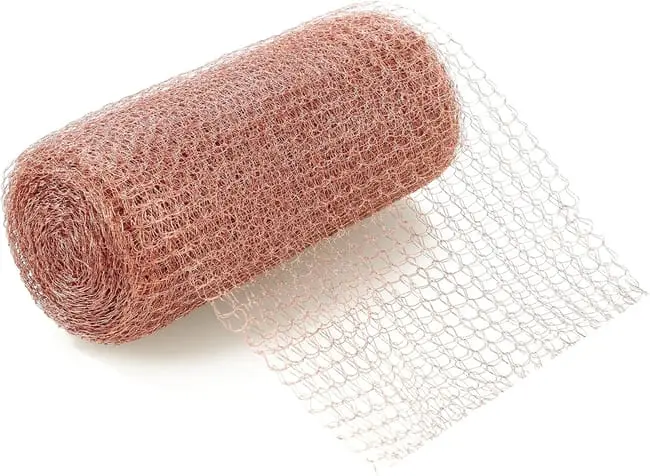
Above, the standard round-wire mesh you’ll find just about everywhere.
3. Review of the Springday mesh with “Twisted Flat Wire” (The Complete Kit)
I’m going to be completely transparent with you: it’s the mesh I use, but above all it’s the one I ended up designing myself. Why? Because I was frustrated by the results of the two previous models. I didn’t want to sell metal, I wanted to sell a solution that saves my own lettuces. Here are the factual differences you can check for yourself.
✅ What’s appealing (the strong points):
-
The physical innovation of the “Flat Wire”: The difference is striking from the moment you unbox it. The mesh is knitted with a twisted flat ribbon. This creates a “double whammy” effect: the slug rests its whole belly on the flat face (contact surface multiplied by 3 to 5), drastically intensifying the electrochemical reaction.
-
The mechanical grip (Texture): The twisting of the ribbon creates an abrasive texture, bristling with edges. Unlike the smooth round wire, the slug can’t “skate”; it is physically slowed down.
-
The Material: Certified Pure Copper (>99%), essential for lasting conductivity.
-
The “Ready-to-fit” Kit: This is the big practical advantage. The box contains 20 bamboo stakes and 20 cable ties for 10 metres. This lets you place a stake every 50 cm, guaranteeing perfect tension (the secret to keeping the mesh an impassable wall).
-
The Service: You notice a real difference in support (a French brand, assembly videos, personalised advice), a far cry from anonymous sellers.
⚠️ What to watch out for (the points to keep an eye on):
-
Micro-Slugs (Juveniles): Let’s be transparent: a few users have noted that once the mesh is very taut, the holes can open up and let baby slugs through.
- The solution provided: The kit includes access to a specific method, the “Double Curtain” technique. As the mesh is tubular, the trick is to open it out and fold one section flat onto the ground, creating a genuine copper maze. Once this technique is applied, the seal is optimal, even against the smallest ones.
⚠️ The Price Objection (And why it’s a non-issue)
-
The Price (An Expense or an Investment?) This is the objection that comes up most often: “It’s twice as expensive as the standard roll”. That’s true. And it’s justified.
You need to change your perspective: don’t look at the purchase price, but at the cost per season.
-
A cheap netting made of thin alloy oxidises badly, and often has to be replaced after one or two winters. Not to mention the cost of the plants (and your time) lost if the barrier gives way.
-
The Springday mesh is made from pure copper. It’s built to last 5 years or more if used correctly.
The maths is quickly done: Spread over 5 years, protecting your vegetable patch with a professional solution comes to a few pounds a year. That’s less than two or three packets of seeds or a tray of 6 lettuces eaten in a single night. Peace of mind has a price, but over time it turns out to be negligible.
-
My verdict: Technically, it’s the most accomplished barrier on the market. It calls for a higher initial investment, but it makes up for it with its durability and the support provided (video tutorials + method ebook). It’s the choice of peace of mind (see the availability of the expert kit by clicking here)
🟢 Rating: 4.5/5 (the technical benchmark for lasting protection)
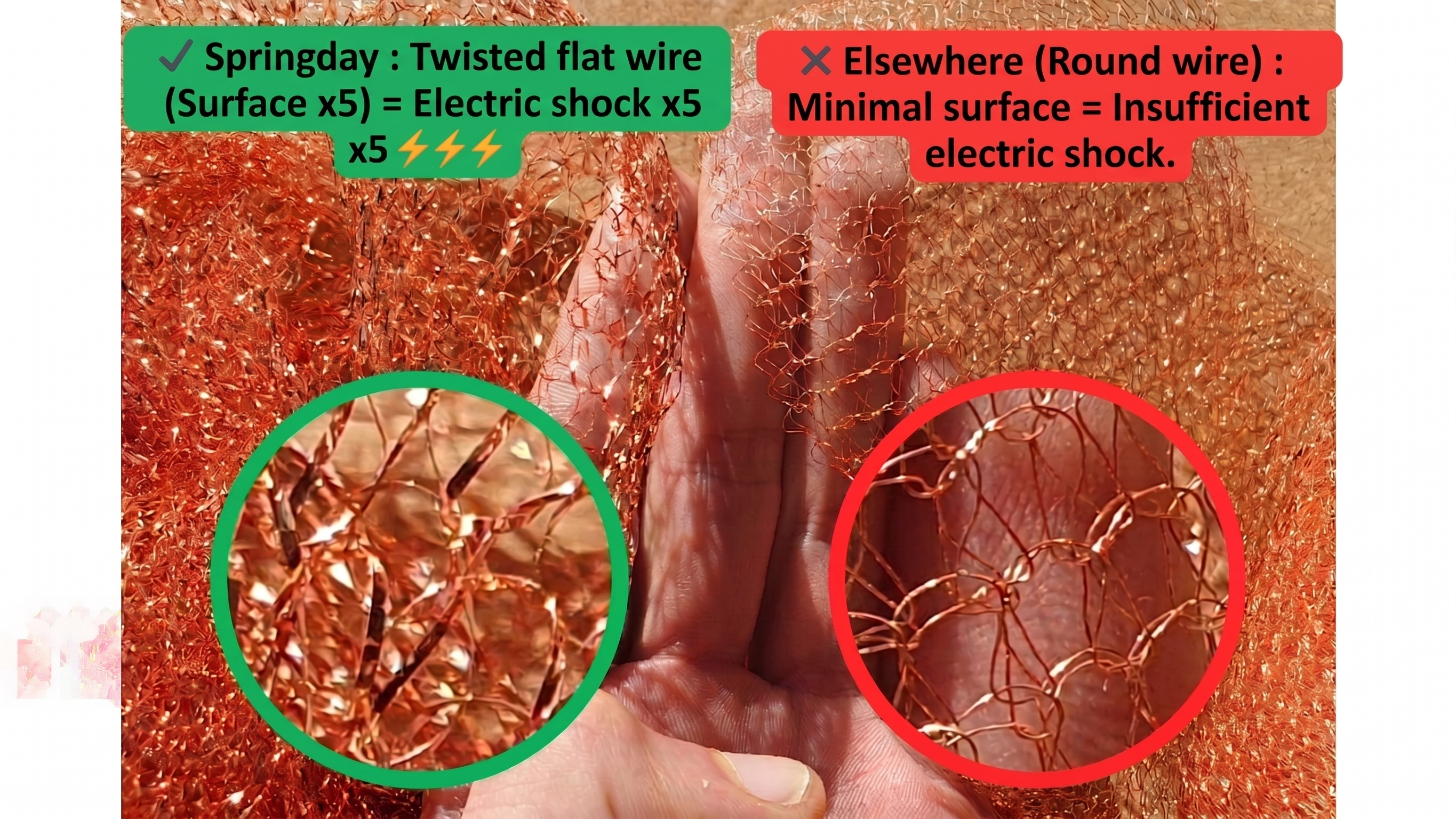
Here, a fairly self-explanatory visual comparison between a round-wire slug netting and the Springday mesh with twisted flat wire.
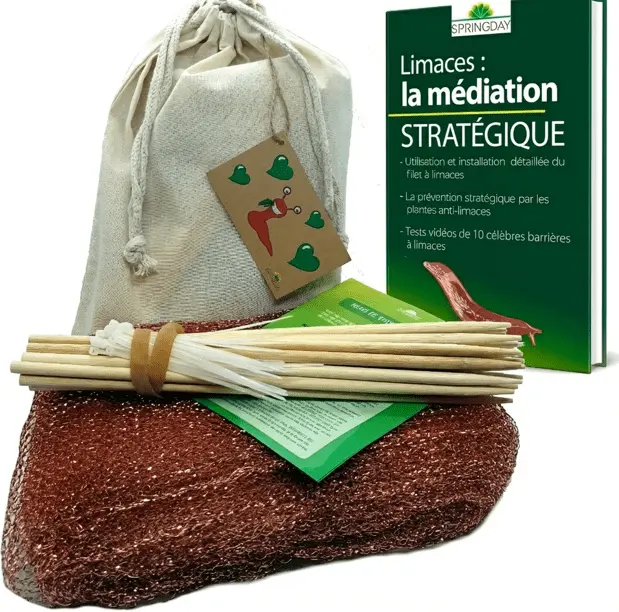
Here is the Springday slug netting as received by every gardener (ebook included)
III. Summary of User Reviews (What They Really Say)
To round off this technical comparison, I’ve analysed the verified user feedback (found on the web). The aim is to put the theory (our tests) up against the reality on the ground.
1. Review of the “Stop-Slugs” netting (Low strip)
The customer feedback on this type of product sadly confirms our concerns about insufficient height.
✅ What’s appealing (the strong points):
- A relative effectiveness: Some users don’t condemn the product outright, like Wilquet, who judges it “not very effective” (rather than useless), wryly assuming he’s up against “competition-grade slugs”.
⚠️ What to watch out for (the critical weaknesses):
-
The height problem: gegorymichelin’s review is damning: “Height too low”. He specifies that “the height is too low, otherwise it works, you need at least 10 cm or even a bit more”. This directly validates our criterion no. 1: a barrier that’s too low is useless.
-
Ineffectiveness in the rain: This is the ultimate crash test. Jidé reports a disappointing experience: “Product absolutely ineffective… One evening around 11 pm in torrential rain […] I noticed that numerous slugs were cheerfully crossing this barrier”. He describes the product as a “Gadget to be avoided”.
My verdict on the reviews: Users overwhelmingly confirm that without adequate height (>7-10 cm), the barrier is crossed, especially in wet weather.
2. Review of the generic “Round-Mesh” netting (The Standard)
This is where the analysis gets interesting. On this type of mesh (often sold in a roll of ~12 cm), the reviews (found on the web) are very divided.
✅ What’s appealing (the strong points):
-
Effective under conditions: Some users, like valerie91760, report “nothing to flag so far” on their aubergines.
-
Decent overall satisfaction: Michel Schopperle notes that “on the whole it’s not bad”, which shows the product can suit some gardens.
⚠️ What to watch out for (the critical weaknesses):
-
Confirmation of the “Ice Rink” effect: This is the technical point we were raising. The user Brette JH reports having seen “large slime trails right on the mesh” and confirms that they “go over the top”. Likewise, Pezet Christelle states that “the slugs climb up on it” and judges the mesh “completely useless”. This proves that the round wire, too smooth, doesn’t repel determined gastropods strongly enough.
-
The mesh problem: Michel Schopperle, though moderate, laments that there’s “always one that slips through the holes” (to be transparent: this is also something that can happen with the Springday twisted flat-wire mesh – the difference lies in the fact that with flat wire, the “fold back the 2nd layer of mesh” method solves this problem.
-
The perceived quality: Amayolo describes a product as “very light, quite thin”, which contrasts with the need for a robust and durable barrier.
My verdict on the reviews: The comments validate the theory: the round wire works as long as the pressure is low. As soon as the slugs are numerous or very determined (slime on the mesh), the barrier gives way.
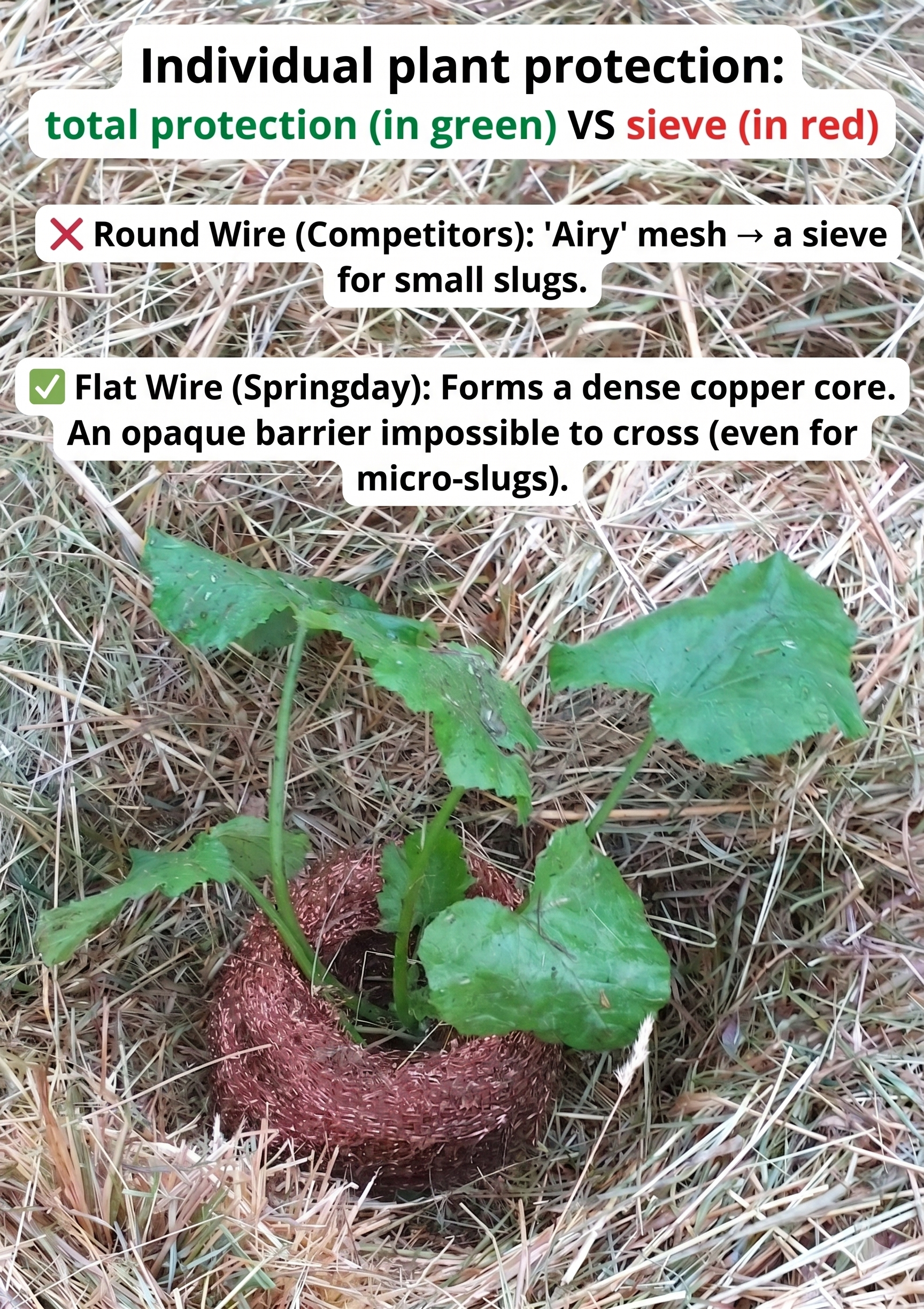
Demonstration of the mesh’s opacity when protecting individual plants. The suppleness of the knit and the total amount of copper offered by the flat wire make it possible to eliminate the gaps (interstices) visible on conventional rigid mesh.
3. Review of the Springday mesh (The Twisted Flat-Wire Kit)
The user feedback on this mesh is particularly plentiful and detailed, which gives a very precise picture of how it performs on the ground. Here is a summary of what the gardeners who use it have to say:
✅ What they rave about (the strong points):
-
A “Radical” effectiveness: “Rescue” stories are legion. Laurent tells how his 24 lettuces were mowed down in 48 hours without protection, then how the next 24, surrounded by the mesh, all survived right through to harvest while the slugs swarmed around them. Roche, in Brittany (a very wet region), confirms: “Everyone’s doing very, very well inside”, while his unprotected beans were “gnawed down to the ground” after the rain.
-
The “Ready-to-fit” Kit: It’s a relief for many people. Christophe and Julien point out that fitting is quick thanks to the stakes and ties supplied. No more headaches working out how to keep the copper standing.
-
The (Human) After-Sales Service: This is the brand’s signature. Many customers (Ritter, Mimi91) thank Robin for his responsiveness, for sending missing parts or for the personalised advice. You can tell there’s a gardener behind the shop, not a robot.
⚠️ The points to keep an eye on (and the validated solutions):
-
Installation calls for care: Some reviews (Plancade, Mélanie) find the fitting a little long-winded, particularly weighing down the bottom of the mesh with stones or ground pegs.
- The expert’s answer: It’s true, the ground seal is the key. You need to take that time at the outset. To be quicker than with stones, Christophe’s tip (using U-shaped fixings) is excellent.
-
The case of “Baby Slugs”: A few users (Wolff Léa, Isabelle) note that the tiny slugs (< 5 mm) sometimes manage to get through the holes if they’re very stretched.
- The expert’s answer: For these specific cases, the “Double Curtain” method (explained in the ebook provided) makes it possible to create an impassable maze at ground level, even for the juveniles.
-
Maintenance (Weeding): Pascal G and DenisDenis rightly point out that you need to weed around the perimeter. If a weed grows and touches the top of the mesh, it becomes a “bridge” for the slugs. It’s a golden rule that holds true for all physical barriers.
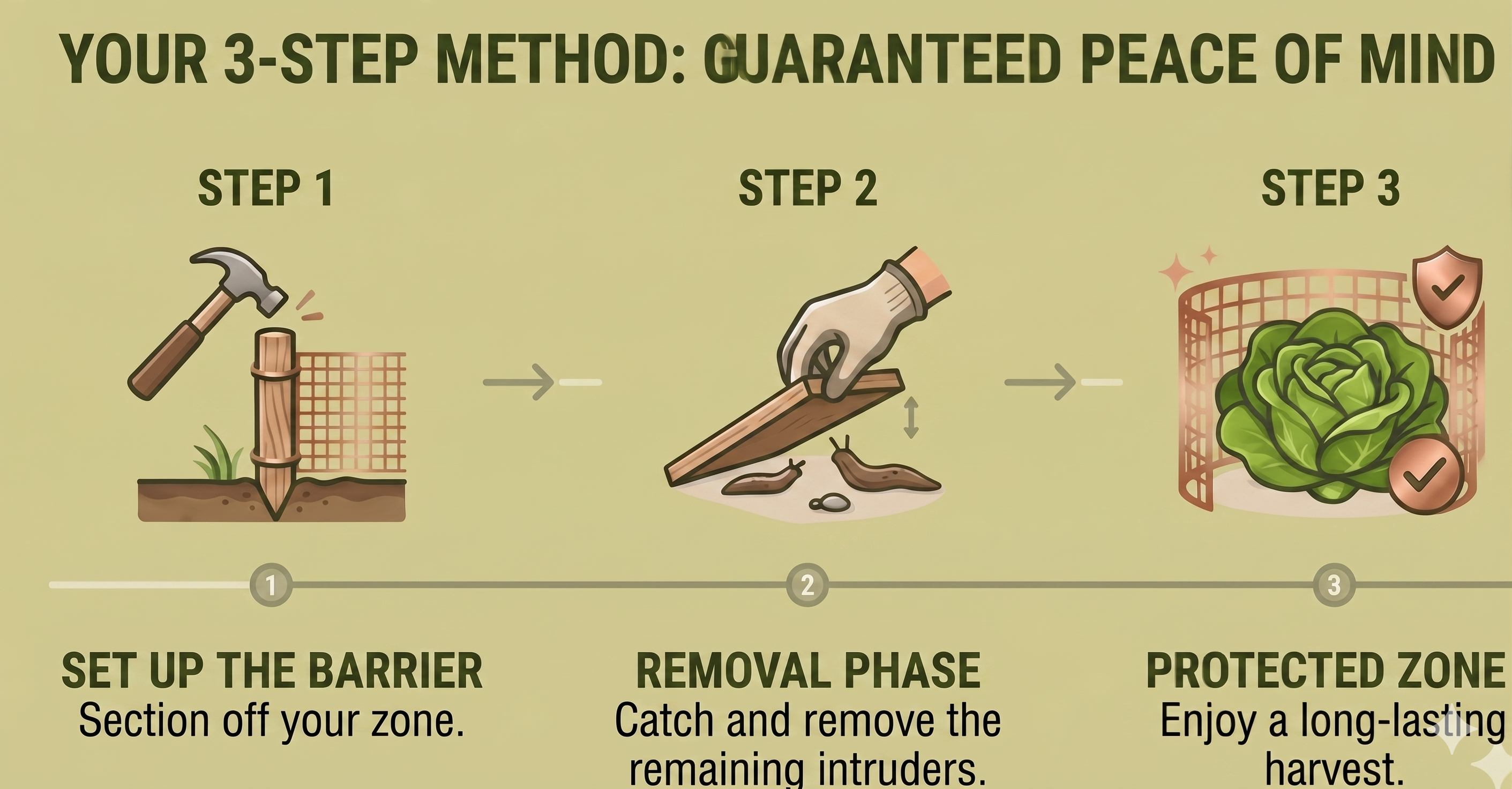
My verdict on the reviews: Overall satisfaction is excellent (often 5/5). The reported failures are almost always linked to an installation error (a plant bridge, a hole at ground level) or to slugs shut inside at the start. Once the protocol is properly followed (notably the “internal harvest” on the first few evenings), the peace of mind seems total.
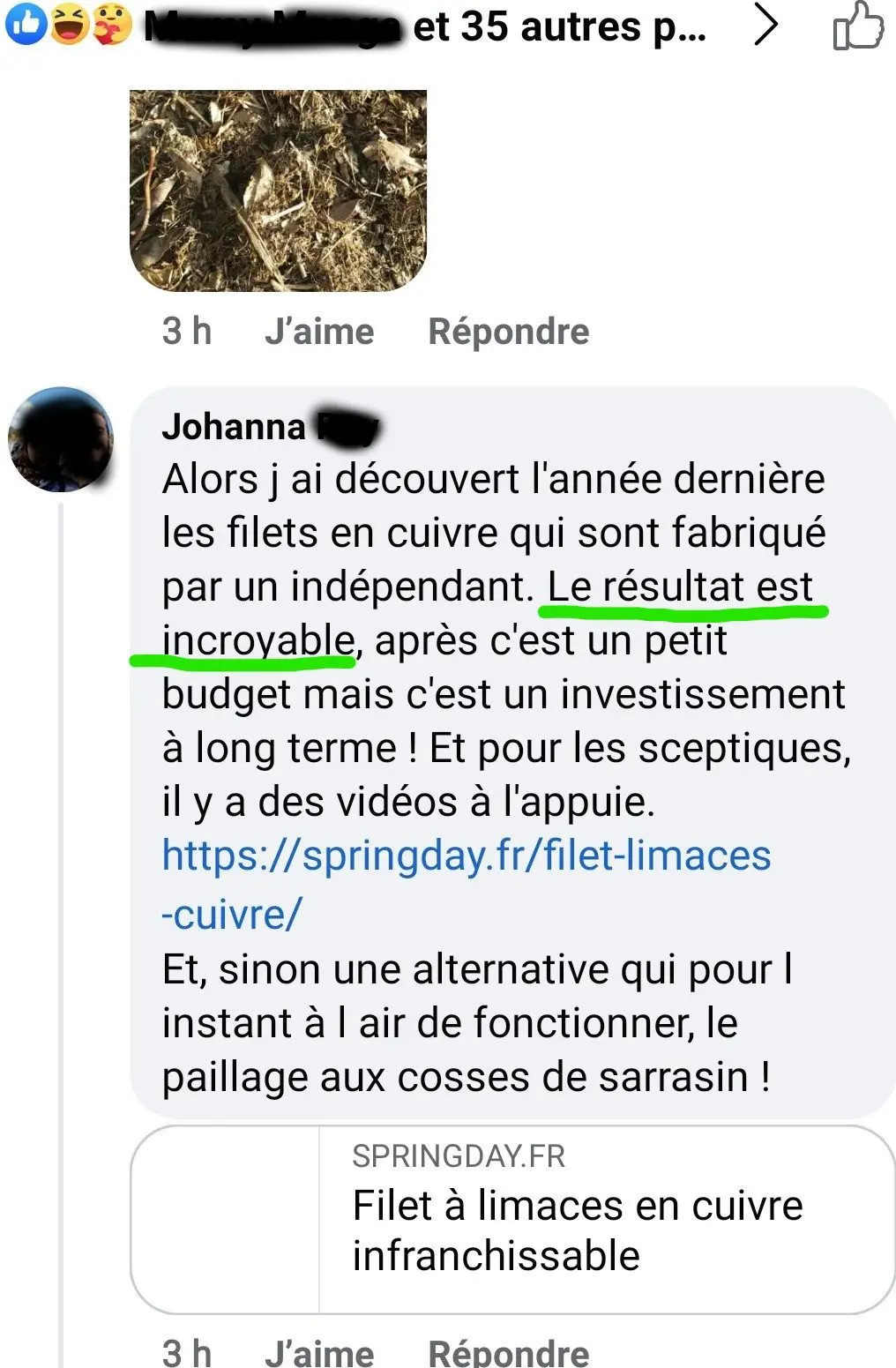
A message found in a permaculture group on Facebook
IV. The Final Verdict (Comparison Table)
To help you take in the technical and practical differences at a glance, here is the summary of our comparison.
| Criteria | Stop-Slugs (Strip) | Generic (Web Standard) | Springday (Expert Kit) |
|---|---|---|---|
| Height | 2 cm (Crossable by stretching) | 10-12 cm (Often sags) | 15 to 20 cm (Held upright) |
| Mesh | Mixed/Nylon Wire | Round Wire (Slippery) | Twisted Flat Wire (Max Contact + Abrasive) |
| Real Effectiveness | Low (Planters only) | Medium (Except in heavy rain or with tough/very numerous slugs) | Maximum (Effective in all weathers & suited to heavy infestations) |
| Accessories | ✅ Stakes included (often “nail” format) | ❌ None (Bare roll) | ✅ Complete Kit (20 stakes + ties + Ebook strategies) |
| Installation | Standard instructions (Theoretical) | Standard instructions (Theoretical) | ✅ Video Tutorials + Method Ebook |
| Customer Support | Standard (Third-party Seller) | Standard (Third-party Seller) | ✅ Expert (Robin) (Direct reply via WhatsApp) |
| Overall Rating | 🔴 2/5 | 🟠 3.5/5 | 🟢 4.5/5 See the Kit |
Conclusion: Should you invest or improvise? My final verdict.
At the end of this comparison, one thing is clear: reading contradictory reviews about the effectiveness of copper is normal, because not all products are created equal.
The effectiveness of a slug barrier isn’t a matter of magic, but of a precise equation. For it to work 100%, you need two factors that “cheap” products often sacrifice:
1. Maximum Contact (Physics): Only flat wire offers the surface needed to generate an electric shock dissuasive enough, where round wire sometimes lets determined slugs “slide” over.
2. An Airtight Fitting (Practicality): The best barrier in the world is useless if it sags or leaves gaps.
Why I recommend the Springday twisted flat-wire kit (despite the price)
I know the Springday Kit represents a higher investment than the generic Amazon roll. It’s the difference between an expense (a gadget you replace every year and that lets 20% of slugs through) and a lasting investment (a pure-copper barrier that will protect your vegetables for the next 10 years).
I designed it to take chance out of the equation. I don’t just sell “netting”, I sell the certainty of finding your lettuces intact tomorrow morning.
🎁 The “Zero Risk” Bonus Because I’m confident in the effectiveness of this flat-wire mesh, I offer what no garden-centre seller will: a 30-day “Satisfaction or Money Back” guarantee. Fit it. Test it. If the damage doesn’t stop, I’ll refund you. It’s as simple as that.
Stop gambling with your harvests. Switch to technical protection.
👉 Choose the netting tested and approved by gardeners: See the Springday Kit
The information in this article has been selected and verified according to the criteria defined in our editorial charter.
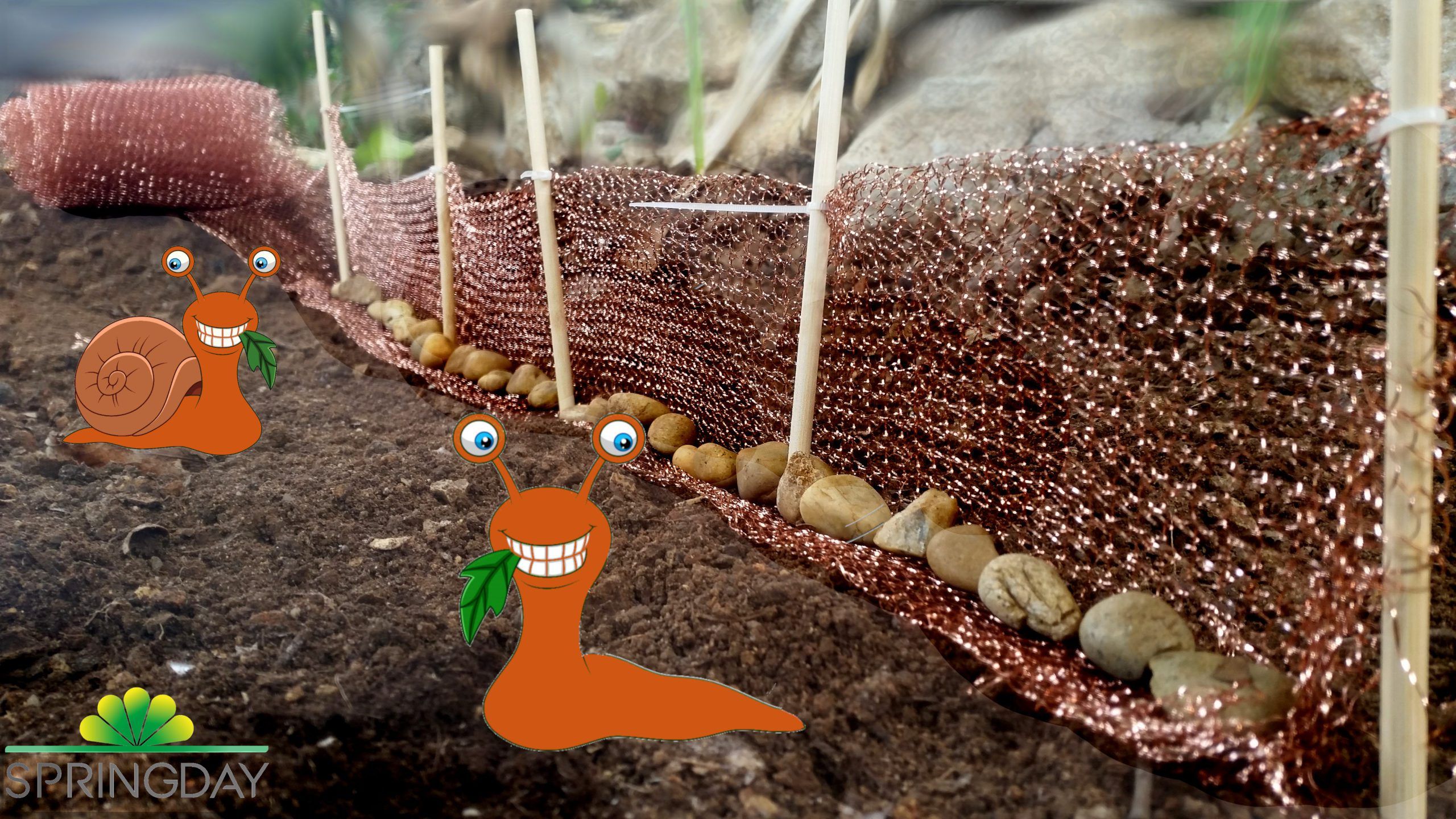
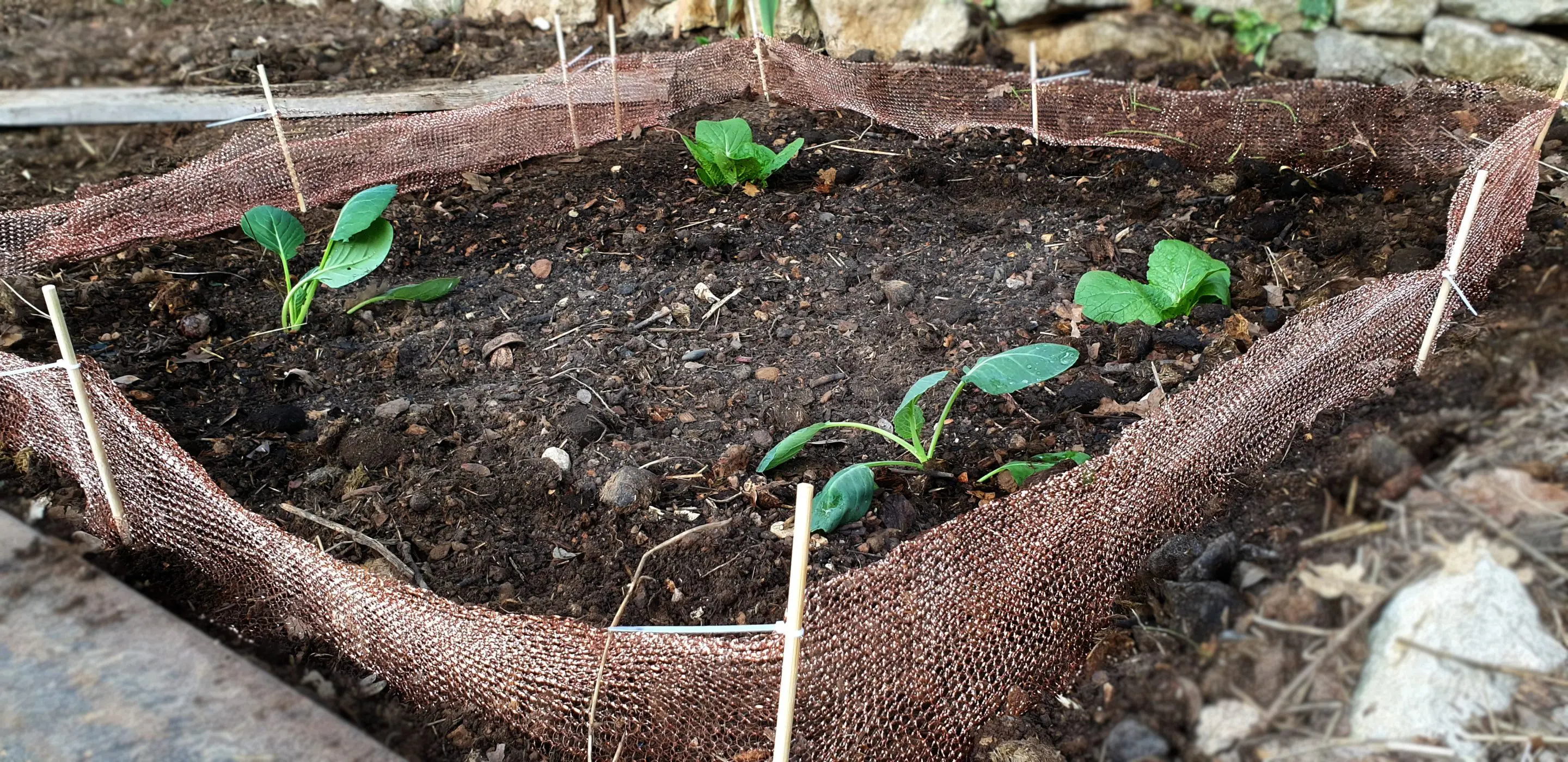
Here is the Springday mesh with twisted flat wire. Once correctly fitted, the ground seal is perfect, thanks to its suppleness.
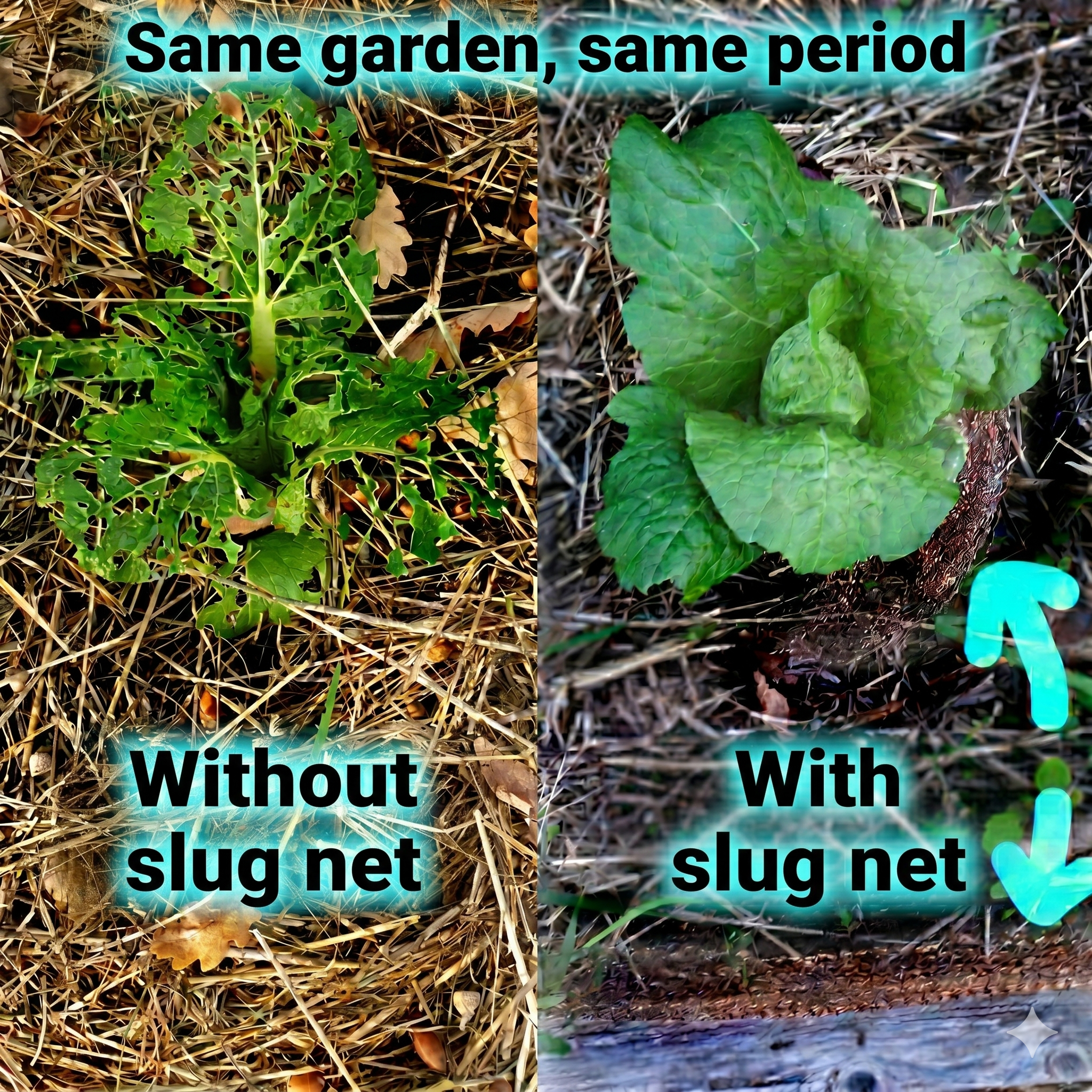
A test carried out in my own garden, over a two-week period (Springday mesh)
❓ FAQ: Frequently asked questions about the effectiveness of copper mesh
Q1: What’s the difference between copper mesh and copper adhesive tape?
Adhesive tape is often designed for smooth surfaces (new pots). In the vegetable patch, on wood or stone, the adhesive often ends up peeling off with moisture, dust and sun. What’s more, the tape is flat: a large slug can sometimes stretch to get over the top without prolonged contact. Knitted mesh (like the Springday) offers a 3D physical barrier (harder to cross) and holds mechanically thanks to the stakes, without depending on any glue.
Q2: Copper oxidises over time (it turns green/brown) – does that reduce its effectiveness?
Yes and no. A light reddish oxidation (cuprite) has no consequences. On the other hand, if a thick layer of “verdigris” builds up with the moisture, it acts as an electrical insulator. It prevents direct contact between the mucus and the metal, which reduces the repellent reaction.
The simple solution: If your mesh turns very green, you just have to clean it for it to become conductive again, as good as new.
- The express clean: Rub with a cloth soaked in white vinegar diluted to 5% or a “bicarbonate of soda + lemon” paste.
- If you’ve let it go: If the mesh is very grubby, leave it to soak overnight in the vinegar mixture, rinse with clean water and dry.
- The Pro tip: To avoid this oxidation, bring your kit indoors over winter (a period when there are no more slugs but plenty of moisture). Your mesh will then last for years.
Q3: I’ve fitted a mesh but I still found a slug in my lettuces, why?
This is the classic “Trojan Horse” phenomenon (and beginners’ mistake no. 1). If you fit the mesh while slugs (or their eggs) are already hidden in the soil or under the mulch at the base of your plants, they find themselves trapped inside the protected zone. The mesh works both ways: it also stops them getting out!
The expert tip: After fitting, carry out a nocturnal “harvest” or set a trap (beer or a slice of cucumber) inside the enclosure for the first 2-3 evenings to clear the zone. After that, you’ll be in the clear.
Q4: Do you have to connect the mesh to a battery to get a current? Is there any danger to animals?
No, absolutely not. The term “electric shock” is a figure of speech to describe the natural electrochemical reaction (galvanic reaction) between the acidity of the slug’s mucus and the copper. It’s 100% self-powered. The micro-current generated is imperceptible to humans, cats, dogs or birds. It’s only unpleasant for molluscs. So it’s a completely safe solution for garden wildlife (hedgehogs included).