Organic slug pellets: do they really work?

If you're discovering my blog, chances are slugs and snails are giving you grief.
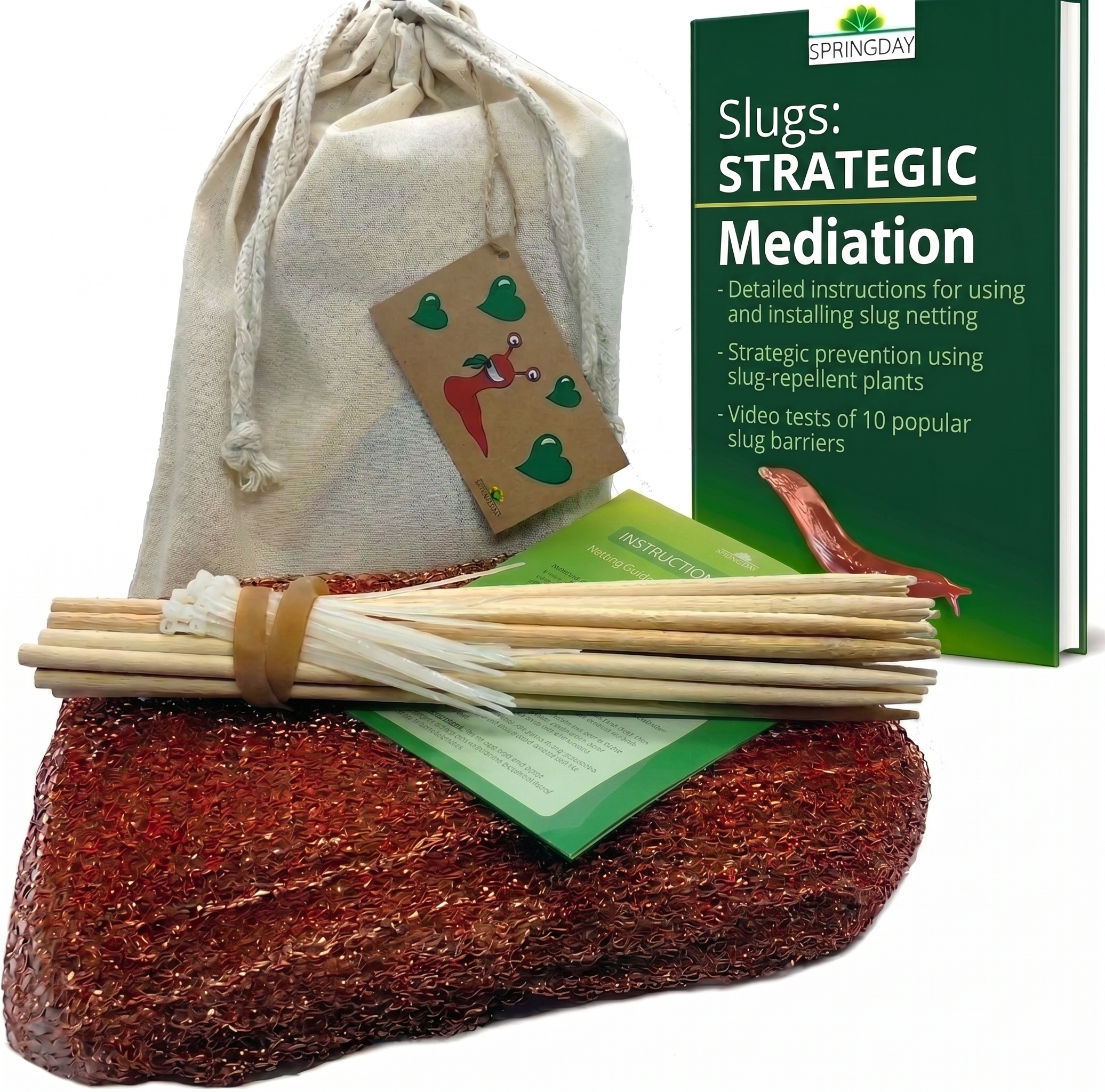
You'd probably be very interested in the copper slug barrier I designed .
It changed everything for me. I can finally grow lettuce, cabbages, strawberries and squashes without tearing my hair out.
Don't hesitate — it's an investment (copper is expensive), but you'll likely save yourself a huge amount of time!
There is a huge range of slug pellets out there. Some are known to be harmful to the garden and its inhabitants. But other slug controls are organic. Does that make them effective against slugs? And are they really harmless in the veg patch? That is exactly what we are going to explore here.
Organic slug pellets: what exactly are we talking about?
In practical terms, every product labelled “organic slug pellets” is a slug pellet containing ferric phosphate (or iron phosphate), which kills the slugs that eat it.
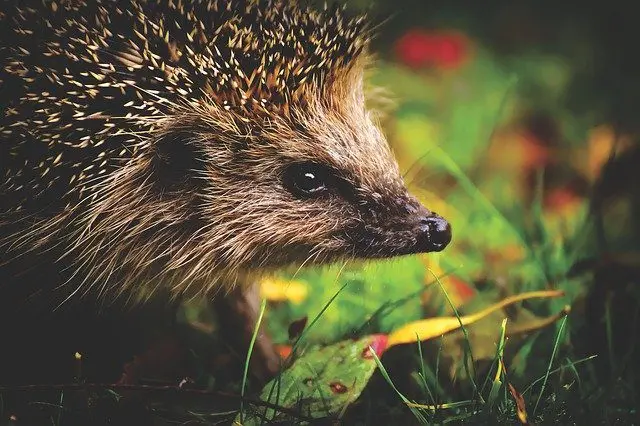
These pellets were originally designed as alternatives to metaldehyde-based pellets, which are carcinogenic and have disastrous environmental consequences (decimated hedgehog populations, danger to pets, pollution, etc.).
Unlike metaldehyde pellets, ferric phosphate pellets are approved for use in organic farming and available for sale to the general public.
In the rest of this article, when I say “organic pellets”, I mean “pellets approved for use in organic farming”, and therefore “ferric phosphate-based pellets”.
These slug controls are generally made up of between 0.8 and 5% ferric phosphate. Bear in mind that the higher the concentration, the stronger the effect on slugs, but also the greater the potential impact on the garden — more on that later.
Online, for instance, I found 3 types of shop-bought organic pellets:
- The first is made up of 0.8% ferric phosphate.
- The 2nd, of 1% ferric phosphate.
- The 3rd does not reveal its ferric phosphate concentration.
Do these pellets work?
To answer this question, the best approach is to dive into the customer reviews:
On Amazon, organic slug control no.1 gathers these comments: “fairly effective”, “very effective”, “poor effectiveness”, depending on the customer. But the rating of 4.1 out of 5 is perfectly respectable.
Organic slug control no.2, for its part, across 4 comments, gathers a “works a treat”, “does the job”, but also a “not effective […] my lettuces paid the price”. The average rating of 3.9 out of 5 is nonetheless perfectly respectable too.
Organic slug control no.3, meanwhile, gathers plenty of positive reviews: “effective”, “extremely effective”, “very effective”… And a single negative review: “barely effective after a few weeks of use”. The average rating of 4.4 out of 5 is very good all the same.
In short, does it work? It would certainly seem so, for the majority of customers. Even if these products clearly do not win everyone over.
So should you rush out and buy some?
Not necessarily. Or at least, not so fast. And we are going to see why.
The first thing one might think: these customer reviews, often requested by the platform 2-3 weeks after buyers receive the product… are frequently feedback on the product’s short-term effectiveness.
What about after 2 or 3 seasons of use? Do the slugs still multiply in great numbers? Are there even more of them than before? Are these gardeners chained to this repeated solution of wiping out the slugs? What are the possible long-term consequences of using these slug controls in the garden?
We discuss that in the following sections.
An ideal solution for managing slugs sustainably in the veg patch?
Hervé Coves, a specialist in managing slugs in the garden, puts it so well: “an overpopulation of slugs in the garden is merely a symptom”. “The symptom of an imbalance in this garden system.”
Essentially, he explains that if our lettuces, cabbages, strawberries and young cucurbits are being decimated by slugs in spring, it is because there is a problem — an imbalance — in our garden.
Generally, this imbalance stems from two issues:
-
A lack of natural predators of slugs in the garden
-
A lack of plant biodiversity in the garden
A lack of predators, because it is these that will sustainably regulate the population of slugs and snails, continuously.
It is therefore essential to put in place a genuine garden design strategy aimed at giving these predators a lasting home (slow-worms, ground beetles, rove beetles, glow-worms, hedgehogs, amphibians, etc.): evergreen hedges, piles of wood and stone, unmown grass, and various other hideaways and shelters… For more information on this, you can read my article on welcoming slug predators into the garden.
A lack of plant biodiversity, because, coming out of winter, if your lettuces are being munched by the slimy creatures, it is often because there is no alternative food. So putting in plants that slugs are fond of is an excellent sustainable strategy. For more on this, I recommend my article on slug-deterrent plants.
Attracting natural predators is something absolutely fundamental to sustainably regulating the slug problem.
But attracting predators becomes impossible if we kill the slugs using slug controls, however organic they may be: predators will not settle in if they cannot find their food.
This point, essential to sustainably regulating the problem, requires letting the slugs live in the garden. Killing them every year means seeing them come back, sometimes in greater numbers, every year. Because the garden is even more out of balance than the year before.
Worth noting too is that slugs are an essential link in the balance of a natural ecosystem.
It is said that they are to the soil what bees are to flowering plants.
Eliminating them intensively is therefore, sadly, the path to a garden in imbalance, a far cry from a permaculture ideal.
And then there is also the question one might ask about the potential impact of repeated use of these ferric phosphate slug controls…
Are organic slug pellets risk-free for the garden?
The packaging on these pellets says yes, they are risk-free.
But, dig a little deeper and you may start to have a few doubts. I will leave you to judge.
Have a look at this:

Source: https://jardinage.ooreka.fr/astuce/voir/672381/phosphate-ferrique

Source: Here
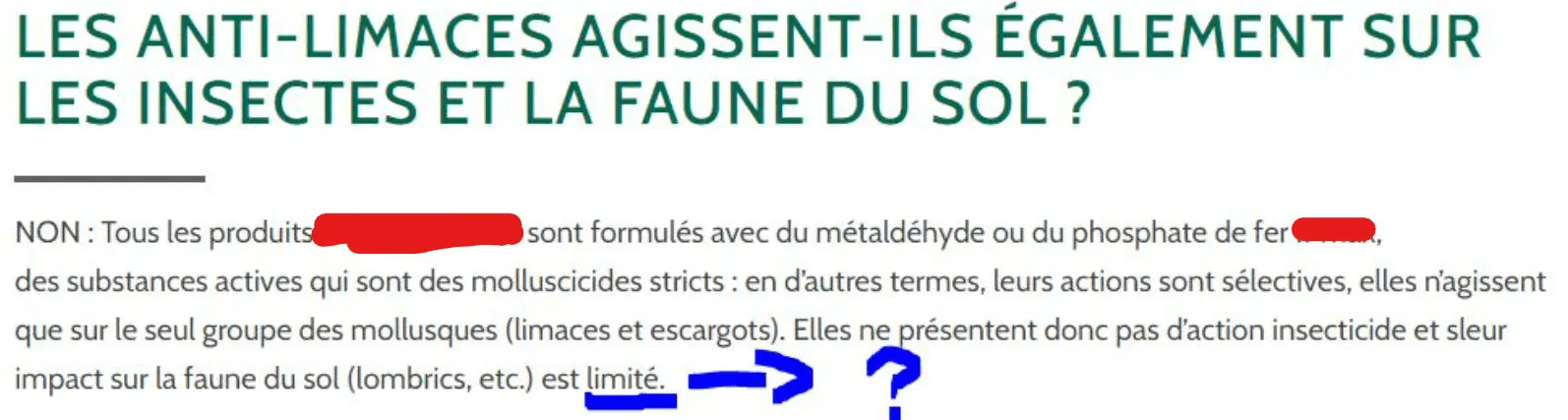
“Limited” means that there is an impact.
This “limited” impact could refer to a potential effect of ferric phosphate on earthworms, sometimes mentioned. Despite a serious lack of data on the subject.
But here is a study I found, on the toxic effect of ferric phosphate pellets on pets: https://www.sciencedirect.com/science/article/abs/pii/S2352007820302432:
- A quote from the article: “A total of 518 calls were recorded (416 in dogs and 102 in cats), of which 163 (149 in dogs and 14 in cats) were considered probable poisoning. The main toxic source is the ferric phosphate-based slug control, which accounts for 50% of calls (of which 28% are probable cases). This product is therefore more dangerous than is often stated on the packaging (frequent claims such as “safe around pets” or “harmless to animals”).
If that is the case for pets, there is every chance to think that the other animals and insects in the garden (hedgehogs?) are affected too.
What alternative solutions are there?
Because yes, it is all very well hoping for sustainable regulation of the problem…
But right now, all your vegetables are being devoured!
So, it is more realistic to have effective solutions straight away, while waiting for that famous natural regulation.
Elsewhere, you will be told to use beer traps, nematodes, or diatomaceous earth.
But, as you will have gathered, these methods are often very counterproductive, owing to the yo-yo effect they cause, by killing the slugs.
To move towards complete and lasting regulation of a slug problem in the garden, we need to turn to methods designed to protect our crops WITHOUT killing the slugs (so that their predators can find them, and therefore settle into the garden).
How do you do that?
With barriers that the slugs cannot cross. And with which you will surround the vulnerable plants in your veg patch.
On this front, forget eggshells, ash, brambles, fine sand, etc. And other old wives’ remedies.
They don’t really work, and/or not for long. You will always have to watch your plants like a hawk.
As proof of what I am saying, you can watch my video tests of slug barriers on my YouTube channel.
In fact, only two barriers are truly effective against slugs:
-
Trenches filled with water, rather like a moat. They will need to be wide enough (at least ten centimetres or so) and deep enough (at least 5 cm). You can use salvaged guttering, which you bury and which fills up on its own with every shower of rain. You will need to surround the veg patch with these water moats. Then remove the slugs from the area in question, until there are none left.
-
Copper, used vertically, more than 7 cm high: this is one of the most effective slug barriers. Because copper, when it comes into contact with a slug’s mucus, generates a slight electric current that is very unpleasant for slugs.
You can see my comparison of shop-bought copper slug barriers here.
And you can also discover the copper mesh for slugs that I designed, following these standards.
Even though it is not an impassable barrier, you can also opt for an effective, free and very easy-to-set-up method: “gift barriers”, that is, barriers that will, on the contrary, attract and hold the slugs in place, to stop them attacking your plants: a good solution is the use of surface composting.
The information in this article has been selected and verified according to the criteria defined in our editorial charter.
Done with slugs. For good. Starting this season.
Bibliography
-
W.E. Gavin, G.W. Mueller-Warrant, S.M. Griffith, G.M. Banowetz,
Removal of molluscicidal bait pellets by earthworms and its impact on control of the gray field slug (Derocerus reticulatum Mueller) in western Oregon grass seed fields, Crop Protection, Volume 42, 2012
This study shows that ferric phosphate pellets gradually disappear from the spreading surface because they are carried away by earthworms.
Related articles
Testing and review of 30 natural slug deterrents (do they work?)
Read
Slug-repellent plants, or prevention through planting
Read
Surface composting: protect your vegetable patch from slugs, with love
Read
Slugs: their usefulness in the garden, what they indicate, and holistic management through reshaping the habitat
Read
Slug predators: which are they? How to attract them to the garden?
Read
Slug control: the (harmful) methods to avoid – why and how?
Read