Building (or buying) your own slug barrier

Slug barriers are probably one of the best solutions for protecting your plants effectively from these gastropods. That said, these fences still need to actually work! Whether they are home-made, bought, or free and readily available, let’s take stock of how effective they really are.
6 natural slug barriers: an effectiveness review
There are a great many natural slug barriers that gardeners, gardening magazines, and online articles recommend time and again.
Yet very often, false information gets passed around. Some famous “slug barriers” turn out to be completely useless.
The proof is in this article and the test videos for each of the barriers mentioned, which you’ll find on my YouTube channel, or in this piece on the Slug control section of the website.
Eggshells
Don’t waste your time: eggshells will do absolutely nothing to bar a slug’s path. They glide straight over them without the slightest trouble.
As proof of this, here is my video test:
And yet, despite all the evidence, some people won’t be swayed. They tell me again and again: “but at my place, it worked!”.
There are two likely causes for this:
1. It comes down to other factors that the gardener never noticed, and therefore never took into account.
2. Poorly cleaned eggshells still hold traces of albumen (the egg white), and slugs are apparently rather partial to it: the effect could be to lure them away from your plants, as they feast on the albumen instead.
Ash
In the second part of the previous video, you can watch the test on ash.
There you’ll see that, when the ash is dry, it forms an impassable barrier.
Yet, as soon as it gets wet, or even slightly damp, its effectiveness drops to zero: the powerful “powdery” and absorbent quality of dry ash is no longer there. And the gastropods then stroll right over it, without any bother at all.
So ash is, in theory, an effective barrier.
But in practice, in the vegetable garden, it is of almost no use: you’d have to reapply it after every shower or spell of dampness (dew), which simply wouldn’t be sensible — especially on chalky soil, where adding ash to the garden should be avoided at all costs.
Fine sand
Let’s keep this short.
The verdict on a slug barrier made of fine sand is the same as for ash: effective when the sand is completely dry. But utterly useless the moment it gets a little too damp.
You can see this in this video (in the 2nd part):
Brambles
Plenty of people share this “brilliant idea” for creating fences that slugs can’t cross. Let’s not be afraid to say it plainly: it’s complete nonsense.
Slugs have no trouble whatsoever moving among thorny branches.
As proof, watch the 1st part of the previous video.
Coffee grounds
Coffee grounds are renowned for their many uses: against plants (yes, against), ants, tiger mosquitoes, and slugs, among other things.
As for their ability to form a rampart against gastropods, you could rate it as good in theory: fresh (that is, still nicely aromatic) or dry (and therefore powdery, moisture-absorbing), they work to bar the path of slugs and snails.
The trouble is that, after half a day out in the open air, the coffee grounds have already lost a good deal of their scent. And come the first shower, or even a heavy, damp dew, they will no longer be dry.
So coffee grounds, out in the garden, aren’t genuinely worthwhile, because in real terms they won’t be effective under normal conditions of use.
For more on the effect of coffee grounds against slugs, your best bet is to turn to my detailed article on the subject, which also includes the test video.
Freshly sliced garlic
For freshly sliced garlic, the conclusion is much the same as for coffee grounds: effective — even very effective — under experimental conditions. But an effectiveness that can’t hold up under real conditions, out in the garden.
With garlic, its strength as a barrier lies in its fumes, which are extremely harsh on the mucous membranes (and therefore harsh on a slug’s mucus: just as they are on your eyes when you’re cooking with it!).
But after a few hours in the open air, the sliced surface eventually stops giving off any fumes as it dries. And so the effectiveness of this repellent disappears.
If you’re curious, here’s a video of the spectacular effect of freshly sliced garlic as a rampart against gastropods:
2 slug and snail barriers to build yourself
We’ve seen it, sadly: all the natural barriers set out in the first part turn out to be ineffective (or extremely difficult to use) under real conditions.
But don’t worry too much. I have two more slug barriers to offer you here. You’ll need to roll up your sleeves, as they take some time to build. But their effectiveness is spectacular. Even if the first one isn’t all that straightforward to put into practice.
Electric slug barrier
The idea here is to build a genuine little electric fence, for raised vegetable beds framed with planks, or directly for planter boxes.
For this, you’ll need electrician’s copper wire (or livestock fence wire), large fixing staples, and a big battery.
Fix the copper wire all the way around the edge of your planter boxes, in two runs: there must be two parallel copper wires (but close enough together: at most 1 cm between the two wires), right around your planter box.
The start and end of this wire must then be connected to a battery. The current then flows through it.
All it takes is for a slug to come into contact with both wires at once, and it will get an electric shock that sends it turning back.
I’m well aware that these written explanations won’t satisfy you, so I’ll point you to this video, where the whole build is clearly explained:
This barrier is effective and simple to build.
But do note — and this is important: the main problem with this system is that the batteries powering it very often need replacing. Because during rain, the run-off water touches both wires at the same time, which quickly drains the battery.
Water moats
Water is one of the most effective slug barriers.
A water trench that is deep enough (around 5 cm deep) and wide enough (around 10 cm) will be an impassable barrier for gastropods.
To set this up, you can use salvaged guttering to build your impassable barrier: seal off the ends of the guttering (to stop the water escaping), and bury it around the vulnerable part of your vegetable garden that you want to protect.
Every shower will fill the guttering, so you won’t have to do it yourself: easy on both water and energy!
To finish, I’ll leave you to watch my test video of water as a slug barrier:
Shop-bought slug fences
If you’re not much of a DIY type, or you simply don’t have the time for it… you should know that there are other worthwhile barriers available to buy:
Metal slug barriers
These metal fences feature an outward-folded edge that makes it very hard for slugs to climb up.
Installed all around your vegetable garden, they will effectively stop the slugs outside from getting in.
All that’s left is to gather up the slugs already inside the enclosure you’ve created.
These slug barriers have the advantage of being nicely effective and pleasingly rigid.
That said, their price can be off-putting.
Copper tape

For a raised vegetable bed or a planter garden, a clever alternative to electric fences is the use of copper tape.
Copper has the property of naturally generating an electric current when it comes into contact with a slug’s mucus, which is highly unpleasant for it.
Used vertically, and over a height of more than 7 cm, copper becomes an impassable barrier for slugs and snails.
So stick copper tape along the rims of your planter boxes, to a total height of more than 7 cm, to seal them off from gastropods.
Be warned: copper tape often doesn’t hold well on wood, so you’ll probably need to consider stapling it on.
Copper mesh for slugs
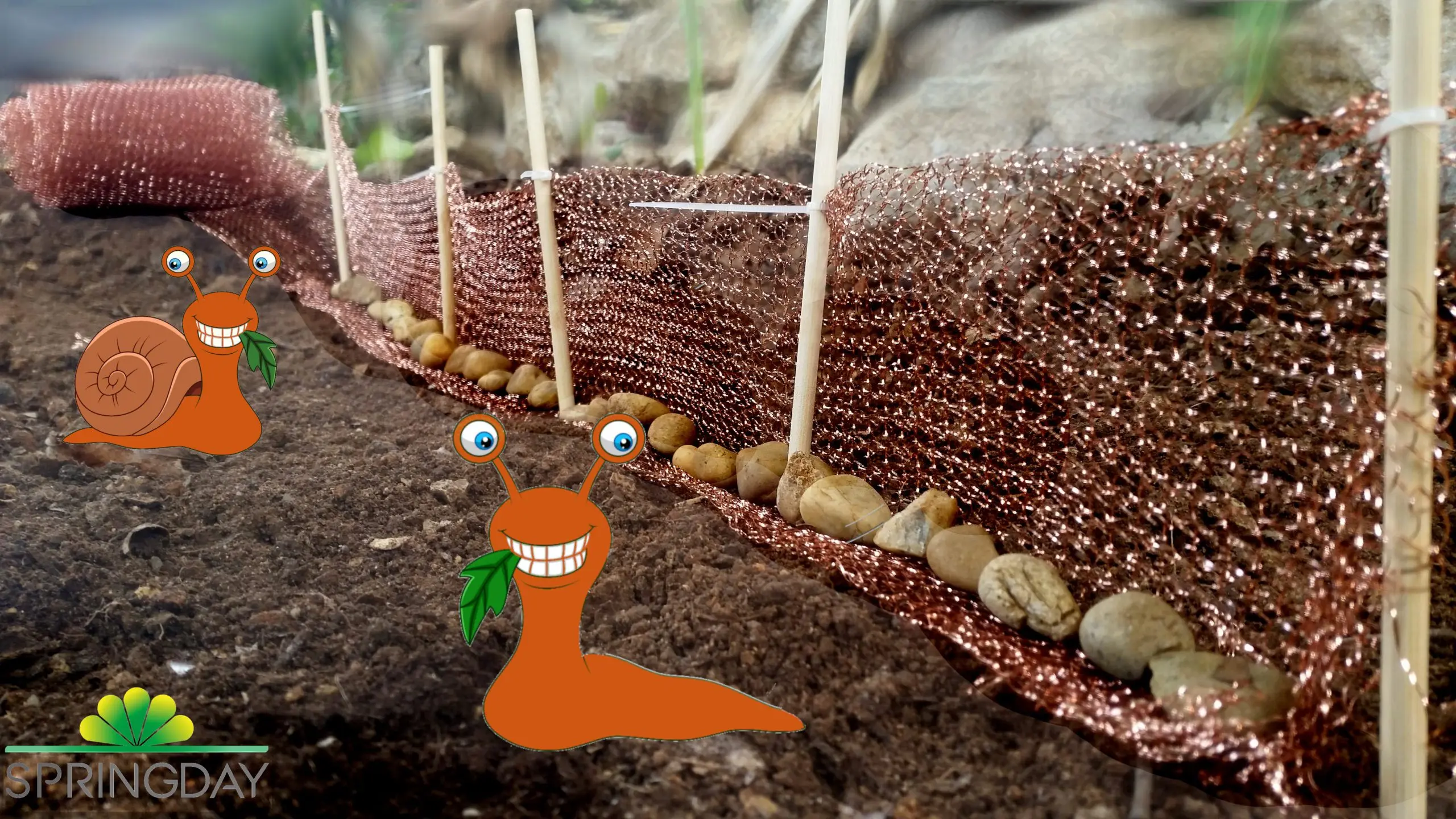 Another use of copper: slug netting, which lets you fence off vegetable beds grown straight in the ground.
Several types of slug netting are available to buy: among them the Springday slug netting (yes, the one I designed myself), 15 cm tall and made of pure copper (sadly rather pricey, given the amount of copper needed for its far superior effectiveness).
There are other slug barriers of this kind. Here you’ll find a comparison of all the shop-bought copper slug barriers.
The information in this article has been selected and verified according to the criteria defined in our editorial charter.
Done with slugs. For good. Starting this season.
Scientific bibliography:
The study examines several different substances for their ability to repel slugs and snails. The results revealed, among other things, that copper had repellent effects.
- Jones, O. T., & Shield, J. M. (2014). Copper barriers and the integrated control of slugs in cereals. Annals of Applied Biology, 164(1), 132-141.
This last study looks at the use of copper barriers to control slugs in cereal crops. The authors ran experiments on cereal plots in the field and compared the effectiveness of copper barriers with that of other slug-control methods, such as slug pellets. The results showed that copper barriers were effective at reducing the damage slugs cause to cereal crops.

Related articles
Testing and review of 30 natural slug deterrents (do they work?)
Read
Slug-repellent plants, or prevention through planting
Read
Surface composting: protect your vegetable patch from slugs, with love
Read
Slugs: their usefulness in the garden, what they indicate, and holistic management through reshaping the habitat
Read
Slug predators: which are they? How to attract them to the garden?
Read
Slug control: the (harmful) methods to avoid – why and how?
Read