Comparison of the best slug barriers to protect your vegetable garden

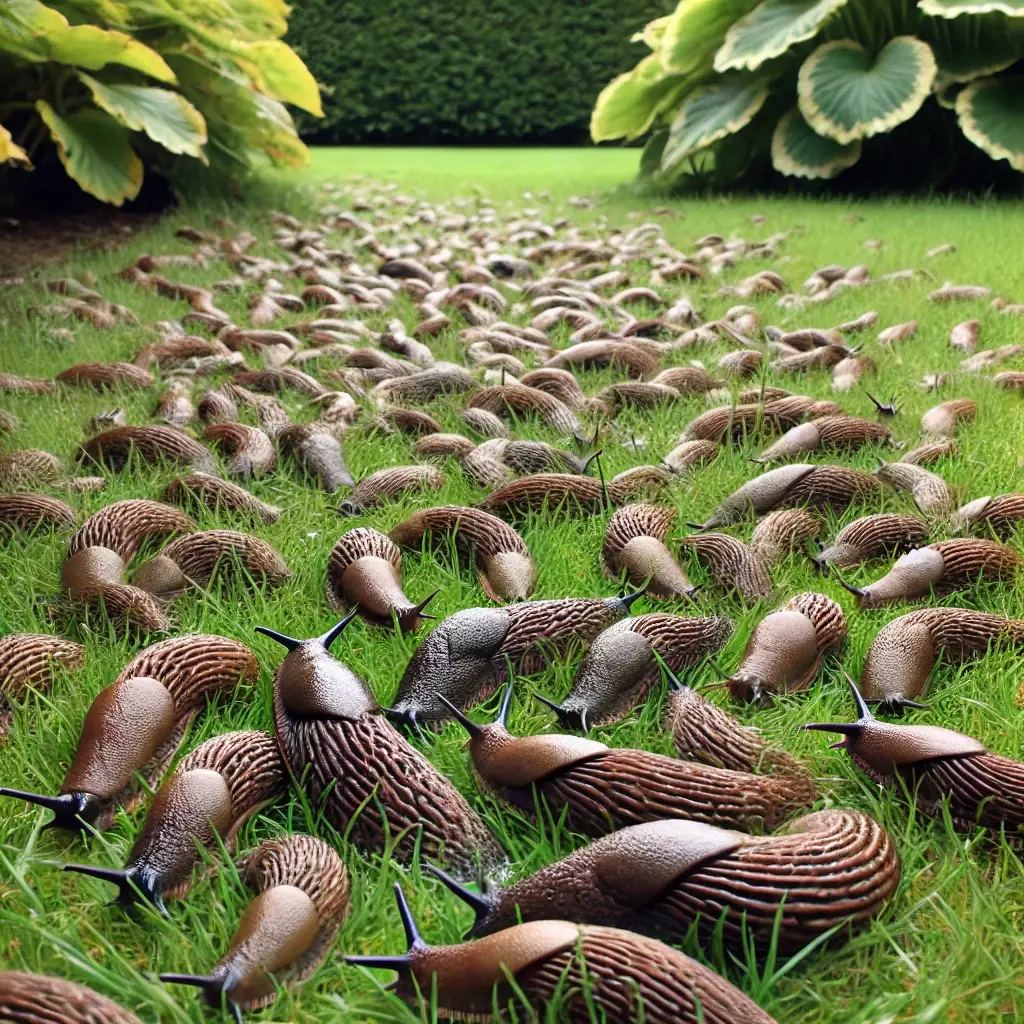
This is only an artistic illustration 😉
Slug barriers are one of the best ways to protect your plants effectively from slugs.
And they do so while also allowing you to manage your slug problem sustainably, in parallel (unlike a great many other slug deterrents).
Why use a barrier like this?
Are they all as good as each other?
And how do you manage the slug problem sustainably, alongside using these barriers?
Let’s take stock here.
So, if the plan appeals to you, let’s get started!
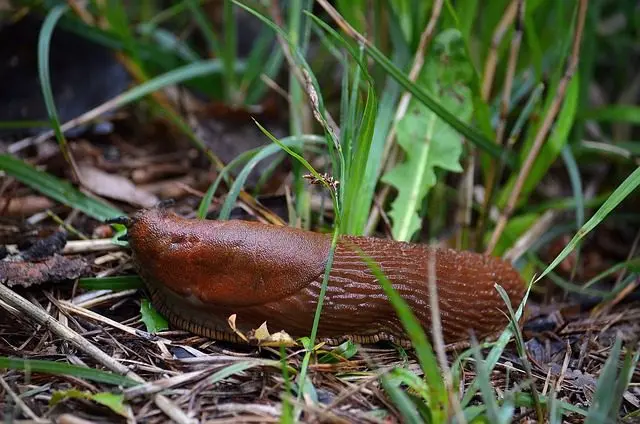
If you're discovering my blog, chances are slugs and snails are giving you grief.
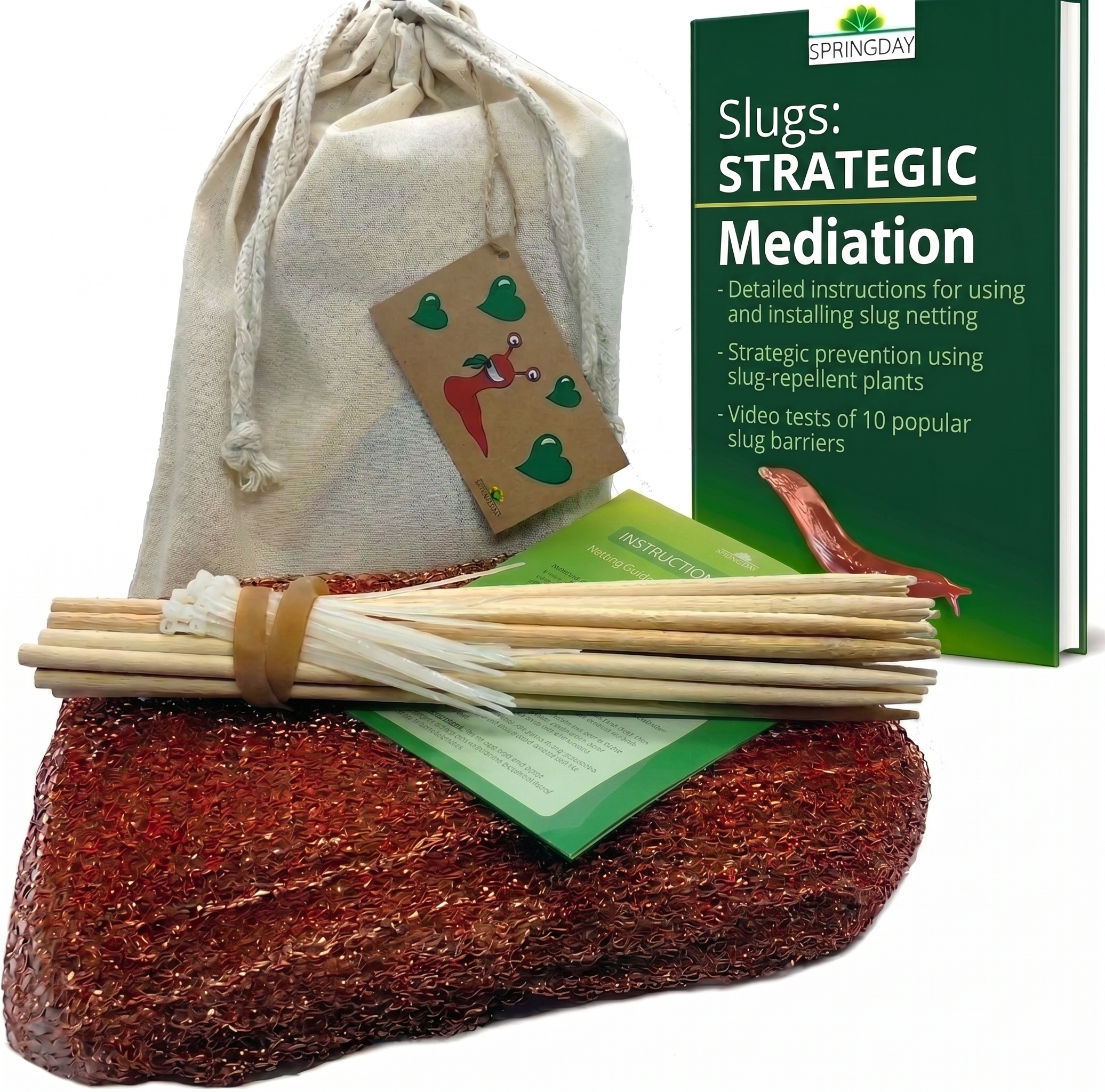
You'd probably be very interested in the copper slug barrier I designed .
It changed everything for me. I can finally grow lettuce, cabbages, strawberries and squashes without tearing my hair out.
Don't hesitate — it's an investment (copper is expensive), but you'll likely save yourself a huge amount of time!
The different types of slug barriers
What exactly is a slug barrier?
A slug barrier is simply a small fence, installed around the vegetable garden, to stop slugs from getting in and wrecking your lovely crops.
There are currently two types of slug barrier:
– Metal barriers with an “overhang”: here is a more detailed description:
-
Material: The barrier is made of metal, often galvanised steel or aluminium, to ensure its durability and resistance to the elements.
-
Shape and structure: The barrier comes in the form of metal strips or sheets that you sink partway into the ground to form a continuous barrier around the area to be protected.
-
Overhang: The distinctive feature of this barrier is the overhang, an angled section or lip at the top of the barrier. This overhang is directed outwards and downwards, forming an acute angle with the rest of the barrier. This incline creates an obstacle that is difficult for slugs to get past, because it is hard for them to grip properly onto this inverted slope.
-
Height: It can vary depending on the model, but it is often between 10 and 30 centimetres.
-
Installation: The barrier is installed by digging a small trench around the area to be protected, then inserting the barrier so that it sits firmly and the overhang is well positioned to stop slugs getting over the top.
– The “copper mesh” type barriers:
-
Material: This mesh barrier is made of copper, a metal known for its repellent properties against slugs and snails. When they come into contact with the copper, these molluscs feel a slight electric shock that makes climbing very difficult and prompts them to turn back.
-
Size: the size of this copper mesh barrier varies considerably from one product to another: it is, for example, 15 cm for the slug netting from Springday, compared with 2 to 3 cm for the stop-slug mesh.
-
Structure: The mesh is made of woven copper. The holes can vary in size, but they are generally small enough to stop slugs passing through. This weave can be made of pure copper, in the case of the Springday slug netting, or of a mix of copper wire and nylon, in the case of the stop-slug mesh, for example
-
Use: The mesh can be used in several ways:
- Surrounding plants: The mesh can be placed around individual plants, groups of plants, or whole sections of the vegetable garden, to form an impenetrable barrier.
- Protecting pots: The mesh can be used to surround flower pots or wooden planters, thus stopping slugs from climbing these supports to reach the plants.
-
Installation: The mesh is easy to install. It can be cut to the size you want with scissors or a knife. Once cut, it is simply placed around the plants or on the ground. Ideally using the stakes provided.
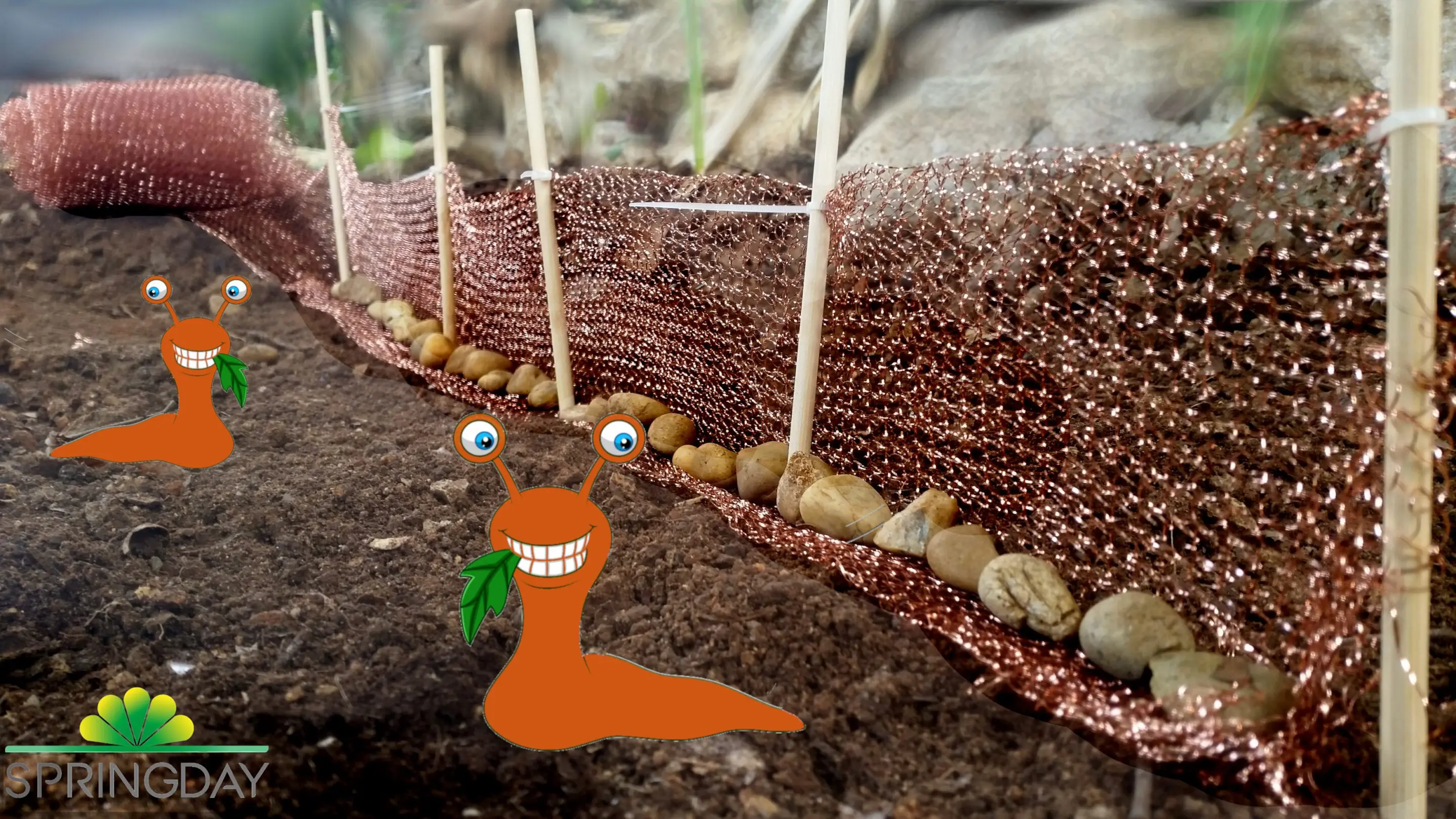
The copper mesh slug barrier that I sell today.
Advantages of slug barriers
As I repeat in every one of my articles, you will need a genuinely thought-through strategy if you want to put a lasting end to slugs in the garden.
And this strategy, as we will see in the final part of this article, absolutely (and counter-intuitively) involves not killing the slugs or even moving them out of the garden (yes, this is no joke).
The only method that allows you to protect your plants without killing the slugs is to use effective slug barriers.
The trouble is that most of the slug barriers shared by all the superficial blogs on the web are completely ineffective. Or unusable in the long run. I’m thinking of eggshells, brambles, ash, fine sand, and so on…
If you don’t believe me, take a look at my video tests here.
The only slug barriers that are truly effective over time are water, which can be used by creating small moats (which, incidentally, can also be considered a slug barrier in their own right!), and copper, used as a vertical barrier of roughly more than 7 cm in height.
As well as the metal barriers with an overhang, mentioned at the start of this article!
Here is the colossal advantage of slug barriers over the other methods of managing these gastropods. They are the only ones that allow real, effective protection of the garden’s plants without killing the slugs. Which makes it possible to put in place, in parallel, a genuine strategy to be done, in the long term and for good, with slugs in the garden.

Drawbacks of slug barriers
The only drawback I see to using slug barriers is the fact that the results take at least a good week to appear. Unlike more drastic (and crueller – at least in my view) methods, such as exterminating slugs with a knife three times a day.
Why a week before you see results?
Because some slugs will, at the outset, be inside the area fenced off with the slug barrier. And for a good week, your job will be to collect every last slug you find within this “enclosure”.
You can even use peelings traps to gather them under boards and so make collecting them easier.
Once the area is finally rid of all its slugs? You can relax, because the slugs from outside won’t be able to get in.
That is the only drawback I see to this method of managing slugs: a certain delay before you can see clear results.
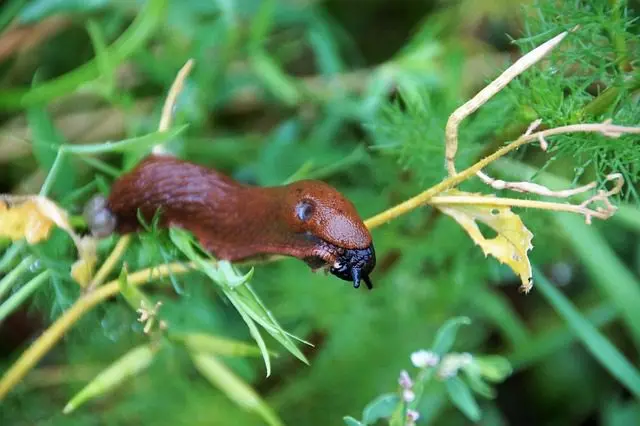
Comparison between the metal slug barrier with an overhang and the copper mesh slug barrier
I have decided to compare these two barriers on three criteria: price, effectiveness, and ease of installation.
So here is that comparison:
Price:
Metal barrier with an overhang: budget around 10 euros per metre of fencing. Often sold only by the metre, I haven’t found any smaller segments.
Copper mesh barrier: budget 37 euros for 10 metres. That works out at 3 euros 70 cents per metre.
Effectiveness:
For large to medium slugs, the effectiveness of the two devices is similar: that is to say, very high. According to my tests, around 95% of slugs (small and large slugs combined) are stopped by the netting, and similar figures are found for the metal fence.
For the very smallest slugs, the metal barrier with an overhang will often be easier to use.
Indeed, as it stands the slug netting can be crossed by the very smallest slugs, which can slip through the holes in the mesh. In the event that too many small slugs manage to get past it, a particular operation is needed: slicing the mesh lengthways, to open it up (it is sock-shaped, tube-shaped, hence the double layer of mesh). Once opened, you fold one of the two sides down to the ground and twist it on itself. This tangle of mesh stops the small slugs crossing the netting by passing through it. I’ve made a video tutorial accessible via the ebook that comes with the netting, but let’s get back to the point.
In short, it works, and very well at that. But it calls for a small operation.
Ease of installation
It is fairly similar for the two devices.
In the case of the copper mesh barrier, you have to be a minimum careful to fix the netting properly with the stakes provided and the fastening system. And you have to press the netting down to the ground properly with small stones. Those are the main points to watch.
In the case of the metal barrier with an overhang, you have to be very careful not to leave a gap between two sections of barrier where slugs could slip through, which isn’t always easy. But the main challenge lies in protecting irregular areas: with barrier sections at least a metre long, that isn’t always easy.
Nor is it possible to use them to protect individual plants, or to protect raised beds.
Verdict
In short, if you have a large, nicely rectangular garden, budget is no obstacle, and you are sure you won’t need to protect individual plants, you should perhaps choose the metal barrier with an overhang.
If your vegetable garden is more “standard”, and you want to keep open the option of protecting individual plants with a more economical solution (one that nonetheless has a price!), you should rather lean towards the copper mesh barrier.
Conclusion and strategy to be done for good with slugs in the garden
If you want to be done for good with slugs in the garden, a slug barrier won’t be enough.
Because what I’m talking about here is being done with slugs throughout your WHOLE garden.
This will let you be infinitely more at ease. And it will give you the satisfaction of having known how to deal with a problem in depth.
This strategy consists of rebalancing your garden. Yes, because an overpopulation of slugs is only the symptom of a deeper syndrome: an imbalance in what we call the garden-system (that is, the garden observed as a system).
This imbalance is caused by a lack of natural predators of slugs, and a lack of plant biodiversity, within your garden.
Predators which, once established, will regulate the slugs continuously and strongly.
While planting a wide diversity of plants will reduce the pressure of slugs on your vegetable plants, by offering them “alternative prey”.
In time, once this is in place, your plants will no longer be affected by slugs. And the latter will, moreover, be far fewer in number.
The role of barriers here is to protect your plants while you wait for the results of these changes. And to do so without killing the slugs.
Because without slugs, their predators will never come and settle in your garden.
I hope you enjoyed this article, and that it has given you new tools to garden in freedom and self-sufficiency, all while understanding what you are doing and why you are doing it.
See you soon,
Robin.
The information in this article has been selected and verified according to the criteria defined in our editorial charter.
Done with slugs. For good. Starting this season.
Scientific references
- The Use of Copper as a Barrier to Slug and Snail Movement – UC ANR
- Slugs in home gardens – UMN Extension
Related articles
Testing and review of 30 natural slug deterrents (do they work?)
Read
Slug-repellent plants, or prevention through planting
Read
Surface composting: protect your vegetable patch from slugs, with love
Read
Slugs: their usefulness in the garden, what they indicate, and holistic management through reshaping the habitat
Read
Slug predators: which are they? How to attract them to the garden?
Read
Slug control: the (harmful) methods to avoid – why and how?
Read